Monday, June 17, 2013

Blue Monday - Scattered thoughts to kick off your week

Untitled
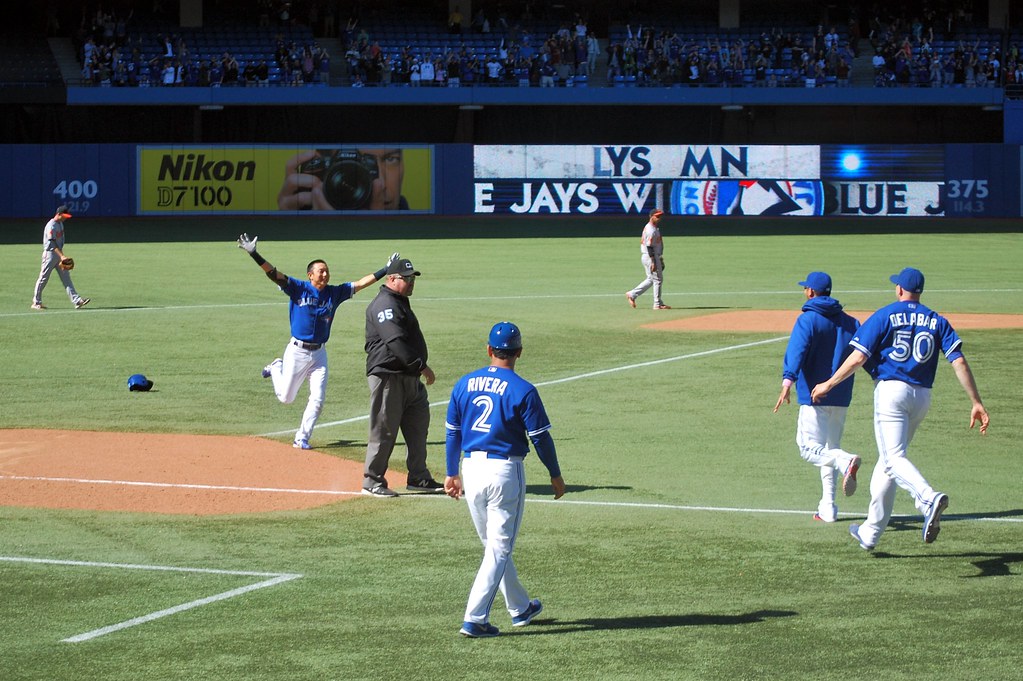
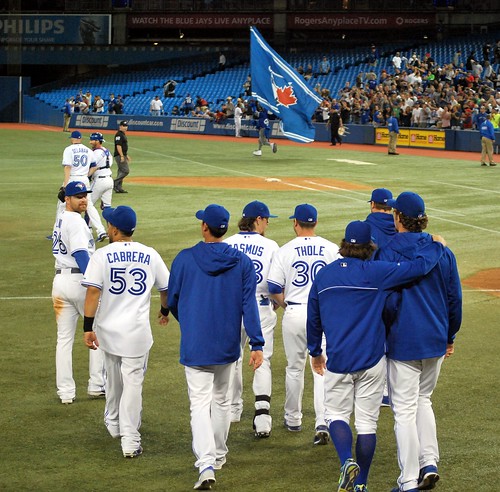
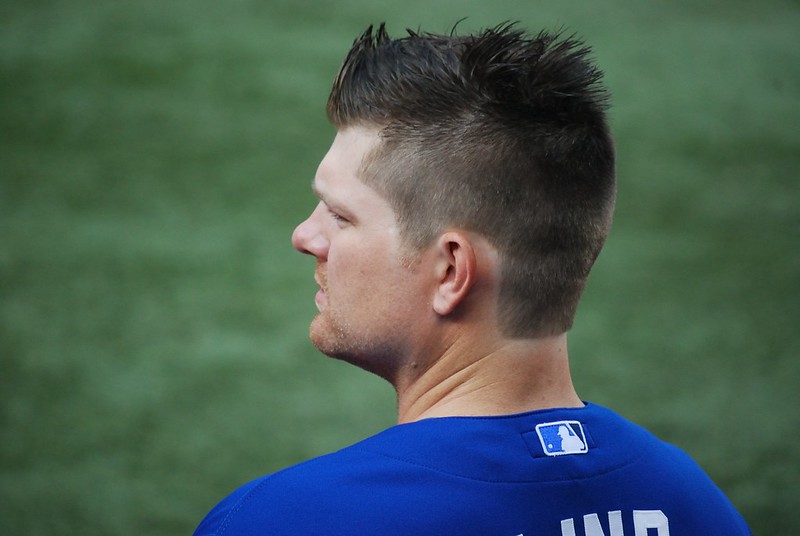
Photo courtesy @james_in_to's incomparable Flickr stream.
More Lindsanity: Last week, it was supposed in this space that Adam Lind's torrid hitting pace was nice, though not sustainable at this level. And then over the weekend, he went 7-for-13 with two homers in three games, bumping his season-long OBP/SLG slashline to .417/.561.

What's more is that Lind has posted better numbers against the same lefties who once owned him. He still only has 25 plate appearances against southpaws, but he has managed a remarkable 13 hits in those matchups, including a homer and three doubles. Obviously, small sample size disclaimers apply, but it would be hard to think of a 25 plate appearance stretch against lefties in any of the last three seasons where Lind had anywhere near this kind of success.

Perhaps the most impressive indicator in all of Adam Lind's stat lines is the sharp decline in the percentage of infield fly balls he has surrendered. In the last two seasons, Lind has posted IFFB% of 10.5% and 9.9%. But this year, with a stronger swing and fewer painful flailings, Lind has dropped that number to 1.9%, which will place him in the top 20 in baseball once he qualifies.

Moreover, Lind has raised his line drive percentage by 6.7% over last year while dropping his ground ball rate 7.6%. All of which points to the fact that he is hitting the ball harder and squaring it up more often. And you can have a lot of success that way.

WAR! Huh! Good Lord!: I'm not particularly clever - nor wise - but as I understand it, Wins Above Replacement are probably best considered at the end of a season, when looking backwards to assess what happened in a year, or over the span of several seasons.

But since they publish the running tab on these things, let's say we indulge in a bit of imprudent number regurgitation.

Most winningly-winning Blue Jay thus far? José Bautista, who has been such a bad example to the rest of the team through his unleaderly ways* that he's posted 2.5 wins above scrub level, according to the Fangraphs tabulation.

Second on the list? Colby Rasmus, who crushed three home runs over the weekend in the Texas heat, and now sits at 1.9, just ahead of Adam Lind (1.8) and Edwin Encarnacion (1.7).

In an odd and eminently notable coincidence, we find ten games of José Reyes from back in April and Muenenori Kawasaki's 53 games of emergency replacement duty tied for fifth on that list with 0.6 wins.

On the pitching side of the ledger, Brett Cecil leads all with a 0.9 mark, while Casey Janssen follows with a 0.8.

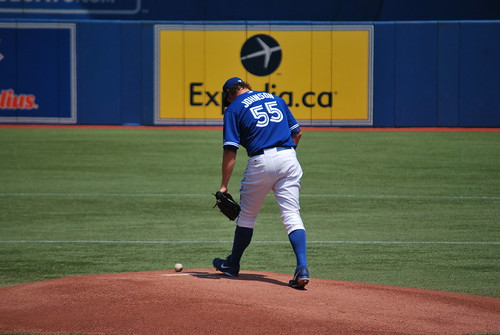
Mark Buehrle has been the most valuable starting pitcher, tied for third Steve Delabar 0.6 wins. Meanwhile, putative staff ace R.A. Dickey is tied with Juan Perez at 0.5 wins. I'm sure Dickey's philosophical about it...or at least has a good explanation. 

Unexpected roster flexibility: Edwin Encarnacion has looked kinda good at third base, hasn't he?

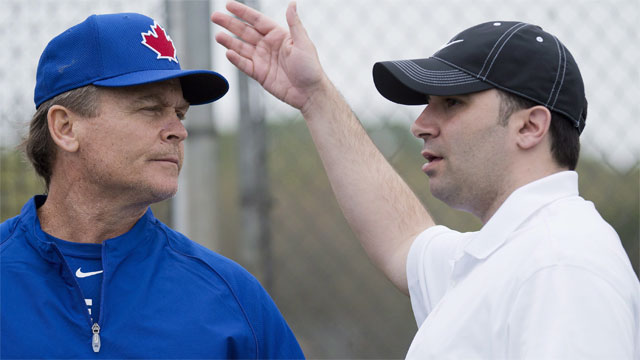
While past experience might lead one to have apprehensions about putting EE there on a regular basis, Jays' manager John Gibbons has seemed to pick his spots well over the past few weeks, since a short bench in NL parks during interleague play pushed him to make the move.

In 61.2 innings at the hot corner, Encarnacion has fielded well enough to make you think that he might be up to the task here and there while awaiting Brett Lawrie's return. It certainly enhances the strength of the offensive lineup should the Jays need to cycle some other bats through the DH slot through the summer months.

Remember the 2013 pitching staff: It was hard to imagine the 2013 season being any worse that last year, when the Jays would require 34 pitchers to get through the schedule. Well, here we are: Not even half-way through the 2013 season and the Blue Jays have thus far employed 29 pitchers.

It's probably fair at this point to say that this emanates in part from an organizational philosophy: The end of the rotation or bullpen slots are not so much jobs that are won as much as they are temp positions that are filled on an as-needed basis. Still, it adds up to a remarkably odd and eclectic list of names that you find filling out the season's roster.

David Bush, Aaron Laffey, Justin Germano, Todd Redmond, Edgar Gonzalez, Thad Weber, Mickey Storey...heck, Ramon Ortiz seems like an organizational mainstay compared to some on that list.

It's almost enough to make you want to run a graceful, slow-motion, black-and-white "In memoriam" tribute over the strains of Sarah McLachlan's "I Will Remember You" to some of these now-departed hurlers.

Except that, you know...for the most part, we won't remember them. Only those among us who take unusual delight in the obscure would want to.

---

*I'm being facetious about this. Sometimes, I assume that this is obvious. But some of you might be reading my scribblings for the first time. In which case: Welcome.

Thursday, June 13, 2013

Various and Sundry Thursday Thoughts: Lind's resurgence and catchers controversies

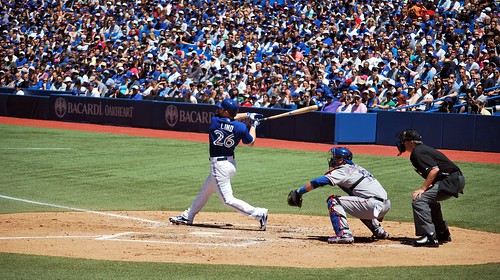
Lind connects for a three run home run.
Photo courtesy @james_in_to's stupendous Flickr stream.
A few whims, notions, impressions and sentiments on the state of the Jays, such as it is...

Lindsanity: The funny thing about the great start to the 2013 that Adam Lind has had is the way that so few are prepared to believe it.

I suppose it makes sense, given the long, slow turgid road that we followed in watching his decline three year death march through the wilderness following his Silver Slugger season of 2009. In the ensuing three years, Lind posted an OPS of .724, saw his effectiveness limited by back problems, and managed to find himself demoted and exposed to waivers. An ignominious fate, to be sure.

Lind might not keep up his current pace - .418 OBP, .540 SLG - as his .391 BABIP seems unsustainably high. But his walk rate is up impressively to 12.2%, over rates of 6.2%, 5.9% and 8.2% over the past three seasons. He's also dropped his strikeout rate down to 16.9%, which is not bad for a power hitting

And to the eye - well, my eye, anyways - Lind's swing looks vastly improved over recent years, as he is back to uncoiling his body through the swing and getting torque from a decent rotation of his hips, rather than the vacant, all-arms swipes of recent memory.

If nothing else, this seasons has certainly complicated the question of what the Jays do with Lind and his three club options for 2014 through 2016.

Catcher Controversy?: The two-guys-one-job discussion is ubiquitous among the sports-talk chattering class, and in large part, these so-called controversies make for easily digestible stories. There are winners and losers. It's binary, and you get to play both sides while urging fans to choose one or the other.

So forgive me if I indulge for a moment in that which I hold in disdain.

The Jays decision last week to bring Josh Thole to the Majors was swiftly followed by speculation as to when he might supplant the struggling J.P. Arencibia as the everyday catcher. And the contrast between the two couldn't be more stark.

In his better moments, Thole is a patient hitter who will get on base (.330 career OBP), take walks (9.1% BB rate) and not strike out too much (12.3% K rate). He'll also not hit the ball very hard (.071 isolated power). Arencibia makes a lot of outs (.267 OBP), strikes out a ton (29% K rate) and walks only on special occasions (5.5% career walk rate, which has steadily declined from his 7.4% rate from his first full season.) Still, Arencibia can smack a tater. A .211 isolated power and .431 SLG are not to be dismissed out of hand.

Toss all those numbers into a big pile, and you can understand how people would divide themselves into two camps. Fewer outs! More dingers! Less slap hitters! More dingers!

Oddly, for the catching position, there isn't a lot of discussion around the relative levels of defensive acumen among these two. Maybe it's because neither are particularly exceptional behind the plate, nor are they wholly awful.

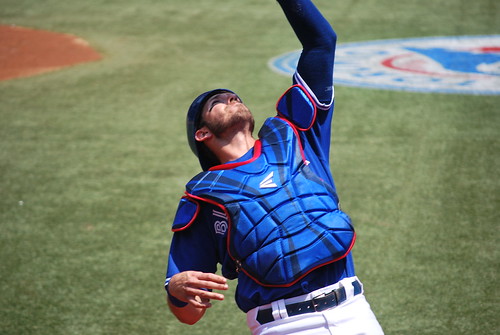
Up until the last game played in Chicago, I might have suggested that Arencibia is unlikely to lose much playing time to Thole given what I perceive to be an undying mancrush that John Gibbons seemed to have on J.P.. All of those at bats in hitting third, fourth or fifth in the order must have come from some level of irrational affection, right?

But seeing JPA plugged into the seven-hole in the lineup - against a lefty, no less - makes me wonder if his last 20 games and 99 plate appearances have been bad enough to take the bloom off the rose. A .202 OBP with 29 strikeouts versus four walks will do that.

Arencibia is likely to remain the incumbent in the coming months, but don't be surprised to see Thole get starters against right-handers with decent breaking balls. And if he succeeds? Well, then we might have a real discussion on our hands for 2014.

And one last note to ponder: Thole is signed to a two-year deal that pays him $1.25 million per year, while Arencibia makes $505,000 and hits arbitration after this season. Which might make this somewhat contrived controversy a little more real by the time we get to the trade deadline.

Programming note: If you want to take me to task on either of today's whims, or just want to discuss the state of the Blue Jays, I'll be chatting on Sportsnet.ca tomorrow at 12:00 noon Eastern Time. Come on by and let me know about the bee in your ballcap.

Thursday, June 6, 2013

Young Man Blues - Where Does Brett Lawrie Go From Here?

Photo courtesy the outstanding @james_in_to's Flickr stream.
If there's one aspect of being a baseball fan that has transformed most dramatically since this blog was launched seven seasons ago, it's the way that young players are taken into consideration.

I remember at various times in the not-so-distant past keeping a watchful eye on the stat lines of players such as John-Ford Griffin, or Robinson Diaz, or Brian Dopirak, or even Chad Mottola, with the full expectation that at some point they would translate their minor league excellence into a career as everyday players with the Jays.

In more recent years, the mark of the more sophisticated baseball connoisseur was the ability to scoff at such middling organizational filler and rattle off the long list of more pertinent and exciting prospects within a system and throughout the game. A new surfeit of readily available resources that rate and rank and analyze ballplayers and teams allowed us to form opinions from our couches on athletes that we might not see at the top level for years...if at all.

Actually, that last part is the one that increasingly preoccupies me. Having indulged in so-called "prospect porn" for the last few years, the one thing that increasingly impresses itself upon me is the high failure rate of prospects. And this isn't limited to your garden variety organizational filler. I'm talking about the number of "blue chip", "can't miss" prospects. The top five percentile that fill the top ends of those perpetual speculative top 100 lists based on the gaudy numbers they post against their peers in the lower, developmental levels. The players who make their way onto a Major League Baseball roster to all matter of hoopla and frantic fantasy baseball waiver wire activity.

All this new information gives us some alleged sense of knowledge on players about whom we know very little beyond the blurbs. But what has been striking over the past couple of seasons are the number of top-flight young players who simply cannot make a go of it once they face real live big leaguers.

Previously, there were players like Jeremy Hermida or Brandon Wood, who stood out because they seemed to be the exceptions as top 10 prospects who never were able to convert that promise into something more tangible. Lately, though, it seems like this list is getting longer in a hurry. This includes premier minor league players like Mike Moustakas, Eric Hosmer, Justin Smoak, Jesus Montero, Dustin Ackley, Gordon Beckham, and yes, Travis Snider.

This failure rate for young players is quite unlike anything you see in the other major professional sports. Basketball, hockey, and football all draft impact players from the amateur ranks and have them producing at the highest level within a year or two. They slide into the professional game seemingly by sheer virtue of their athletic prowess.

Which brings us to this month's whipping boy, Brett Lawrie.

There's little question that Brett Lawrie is an exceptional athletic specimen, and that certainly helped him push his way into the major league lineup ahead of schedule, at 21 years of age. He made the leap into MLB after just 326 minor league games. That's fewer games than it took for Roberto Alomar to make it to the big leagues. It's almost a full season less than it took for Tony Fernandez to make it and it is about half as many games as it took for Carlos Delgado to crack the premier lineup.

It probably helped that the Jays needed to show some return from their trade of opening day starter Shaun Marcum while a mixed bag of third baseman barely held the spot warm for him. Meanwhile, Lawrie posted numbers in Las Vegas that were otherworldly, and beyond what he'd ever posted before in his minor league career.

Lawrie's debut with the team in the latter stages of 2011 was something of an astrological event. New-found plate discipline and a hell-for-leather approach to all other aspects of the game made him appear to be something more than an all-star. Lawrie appeared destined to become a transcendent sports figure in Toronto, and one who brought non-baseball fans into the fold. One needed only look at the names and numbers on the backs in the crowds at the Rogers Centre to see whose stardom shone above all others.

But like those many other phenoms before him, Lawrie began to struggle as the league became more acquainted with him. In 162 games in the two seasons following his sparkling debut, Lawrie has posted a .710 OPS (.311 OBP) and an OPS+ of 91. While his defense has been sterling and continues to improve, the more difficult to master tool of hitting seemingly continues to slip away from him.

Which brings me to my point, as much as I'm talking concentric circles around it: Baseball is hard. Really hard. It's harder than we as fans realize. Even more so, harder than some players realize.

And if there is an existential quandary that is leading Brett Lawrie to mow further down into his nail beds, throw equipment hither and yon, pout intensely and point fingers at his teammates, it's might just fact that this game which he had mastered (well, somewhat) at most every level is suddenly beyond him at this point.

Okay, let's slow down for a moment. We're moving into an area of speculative, long-distance psychology, and I'll cop to being on the shakiest of ground in proceeding down this train of thought. But given that Brett Lawrie's name has been often accompanied with a question mark in recent days, indulge me for a moment as I hypothesize on what's going on in his head, and where he needs to go to get through the other side.

Here's the short form of how I think Brett Lawrie's mind works: "I want something, and if I want it bad enough, I've gotta go get it. Take it. It's mine if I want it." I base this on the "Never Surrender" tattoos, the times when he's been thrown out on the bases like a nincompoop, and often, the defiance in the post-game interviews when it all goes wrong.

All of this adds up - in my mind, anyways - to a player who attacks the game. Takes no prisoners. Lays the smack down.

But baseball is a game that doesn’t cotton to being attacked.

It requires a quiet, steady approach. A marksman’s still hand and slow heart beat, not the furious anger of a shootist. It requires patience, not haste. An ability to let the game unfold as it will. A sense of perspective, and an ability to fail with grace.

You gotta be chill, bro.

The problem with this is that Brett Lawrie has been consistently rewarded for his unbridled enthusiasm. From the fans to the front office to his own father, Lawrie's single-minded competitiveness seems to be the attribute for which he is admired and rewarded.

He became something close to a folk hero for throwing his body over barriers, regardless of the damage he caused to himself. People laugh at the notion that he pumps himself up with unhealthy amounts of caffeine in anticipation of a game, figuring that his jacked-up athlete's body will insulate him mood-altering doses of substance that affect the neurological and nervous systems.

And then we wonder he's jumping at pitches.

It could be that the most recent onslaught of negativity could provide the impetus for Lawrie to reevaluate his approach. Maybe this is a learning experience, and somehow, he can learn from the bad times and adapt his game appropriately.

It wouldn't surprise me if he does. In spite of his dude-bro exterior, I've always suspected that there is a very clever and quick mind underneath it all. I think he can adapt, and I think he can transcend from the player that he has become to the player that he could very well be.

But to get there, Lawrie has to want it. And you can't find stillness of mind with the body's hustle.

Wednesday, June 5, 2013

What Have We Learned So Far?

In recent years, when the Blue Jays invariably get off to an underwhelming start, folks ask me: At what point does a bad start become a bad season? Is this really this bad? Or is it even worse than it seems?

While I'm usually patient enough to see the season through - or at least beyond the All-Star Break - I've been known to tell people that they can ask me for my opinion on the state of the club sometime after June 1st. Sure, it's still too early, but maybe we'll have seen enough to at least discern something vaguely meaningful out of the season a third of the way in, right?

As Aaron Neville might croon in falsetto, I don't know much. But here's what I think I've gleaned about this team after 58 games.

You Can't Live Without Starting Pitching: It doesn't matter how many additions the Jays make to the roster, or how many new arms have been brought in to reinforce the pitching staff if they don't have good health.

If your pitchers are inactive (Josh Johnson, J.A. Happ, Brandon Morrow) or ineffective because of injury (again, Morrow as well as R.A. Dickey), there's no amount of pre-season optimism that can backfill the gap left by these diminished returns and absenteeism.

Whether if it is bad luck, a small sample or nagging injuries that are irritating the Jays' starters, the output has been far below expectations so far. Of the five pitchers in the rotation on Opening Day, only J.A. Happ has managed to keep his ERA below 5.00, and that's by a very slim margin indeed (4.91).

Weirdly, their best starter - in a small sample and purely based on ERA - might have been Chad Jenkins in his three unexpected starts last month. That's probably not the way they drew it up in the front office.

Don't Hold Your Breath on Ricky Romero: Without speaking in absolutes about whether if Romero's career is over - because that seems to be the perpetual question - it's safe to say that there are profound issues with the pitcher who was once the Jays' Opening Day starter.

At the end of the 2011 season, it seemed as though Romero lost something, and I wrote it off to fatigue. I also probably gave him credit for gutting it out and persevering through when he didn't have his best stuff.

But the ensuing season and this spring's near-meltdown only serve to reinforce that there is something amiss with Ricky Romero that mechanical tweaks and minor league assignments likely won't fix.

Is it an injury? He had "minor" elbow surgery in the offseason, in addition to the platelet-rich injections that he received in his knees this spring. His delivery has increasingly looked like a collection of jerky component movements, though it was never the prettiest from the outset.

I still have a suspicion that there is a shoulder issue, as Romero's release point looked to be affected at time last year, and wasn't consistent with the one he used in his better seasons.

Whatever the case, it's probably best not to expect any positive input from Romero in any role with the team any time soon.

You Can Play A Lot of Positions Without Playing Them Well: If there was one aspect of the Blue Jays that excited me in the offseason, it was the notion that the lineup would be tremendously flexible given the number of multi-position players who were acquired.

Add in the number of switch-hitters, and it seemed like a roster that could not be game-planned into submission.

The admiration of this adaptable roster probably had a lot to do with years of playing fantasy baseball, and drooling over players who were eligible to play in a number of position slots. 

But what has been striking is the degree to which those players are not actually trustworthy in the field. There was a lot of noise in the defensive metrics for players like Mark DeRosa, Maicer Izturis and Emilio Bonifacio, in part because those numbers are always hard to decipher or trust, and in part because they rarely played any position long enough in any given season to give a decent sample for what their respective capabilities were.

But having seen them in action, it appears that both are best used as marginal second basemen, and in a real pinch, you might be able to swing them into short or third, but not for any amount of time. Bonifacio looked particularly out of place in the outfield, necessitating the early recall of Anthony Gose.

What was a perceived strength is probably a bit of a weakness in the longer term.

Love the Long Ball. Loathe the Long Ball: The Blue Jays are among leaders in home runs, and really, who doesn't enjoy themselves a good tater. With 73 round-trippers, the Blue Jays sit fourth in the majors.

Edwin Encarnacion, José Bautista, J.P. Arencibia and even Colby Rasmus have been around the leaderboard in homers through the first third of the season, and while that doesn't guarantee 40 bombs or anything when it comes to wins, it should put to rest some of the long-standing gripes about the lack of power that the Jays have.

It should, but it probably won't. That's the nature of gripes, I suppose.

On the other hand, the Jays' starting pitchers are all giving up home runs at a rather alarming rate. Brandon Morrow's homer-to-flyball rate has always been a chink in his armour, and one which is glossed over by nerd stats that consider the conversion rate of the former to the latter as something of a streak of bad luck.

Even if you doubt that formula, the fact that this number is climbing for Morrow (15.7%, up from a career rate of 9.7%) is not a happy development.

Among the other starters, Johnson, Dickey and Buehrle are all posting a HR/FB rate in the 13% range (13.8%, 13.5% and 13.1% respectively.)

Brett Lawrie Is An Enigma: But more on that tomorrow.


Sunday, May 26, 2013

The Last Samurai

Photo courtesy the outstanding @james_in_to's Flickr stream.
Every now and then, I'll do a quick search through the MLB.com archives and re-watch John McDonald's Father's Day home run in 2010.  If you're not familiar with the story behind it, you can do it now.  I'll wait here.

I love that moment.  In the middle of June, a Sunday afternoon that saw Jays pitching give up homers to Aubrey Huff, Freddy Sanchez and Pat Burrell in a 9-6 loss, many fans were given a poignant reminder of why for so long, they were so attached to a good-field-no-hit utility infielder.  Even knowing his bat was more likely to be knocked out of his hands than to produce runs, many of us still swooned over the surprising range and lightning-quick hands he displayed in a Jays uniform.  It was the unlikeliness and unexpectedness of that homer, the fact it came from John McDonald, that made it so special.

If you understood his limitations, you might be willing to look past them.  If you didn't, you might be easily persuaded he was a better player than he was.  When pressed into something close to full-time duty, he was frequently adequate, occasionally dazzling, and usually made us happy even in failure.  When he left because he wasn't needed anymore, as players like John McDonald inevitably do, all it did was raise questions about if he would come back.

But Toronto was shopping for something better in the middle infield, and particularly at shortstop, which had been a bit of black hole for a decade or so until Yunel Escobar landed in their laps and seemed to have put things in a more stable state.  When it was discovered last year that the words "Yunel Escobar" and "stable state" should never appear in the same sentence together, they traded up to the dynamic Jose Reyes, who promptly maimed himself.

All of which brings us to the inimitable Munenori Kawasaki.  I'm not sure Kawasaki has quite earned the "journeyman" tag the way McDonald had, given his long prior career in Japan and only one full MLB season under his belt.  Yet here he is, 31 years old and pressed into something close to full-time major league shortstop duty for the first time, in the absence of any better options.  John Gibbons, who was around during part of John McDonald's Toronto tenure, has run him out there regularly, I'm sure knowing full well that this is a player who, albeit in only 226 plate appearances entering today's game, has posted an OPS 46 points lower than our offensively-challenged Johnny Mac.

And yet, he continues to fascinate.  That's the right word, I think.  I can't say "amaze", because his actual performance falls well short of that.  I can't say "surprise", because while his numbers are a little better than what he showed last year in Seattle, we're still not within a large enough sample to determine what the mean is, and whether he needs to get better or worse to regress to it.

I'd resisted writing a post about Kawasaki, despite my enthusiasm for him.  Not to put too fine a point on it, but my enjoyment of his presence was mostly because he was a .gif-able novelty.  But as time has progressed, I didn't want to fall into a trap of thinking he's something he isn't, or make a case for him to stick around much longer than it takes for Jose Reyes' ankle ligaments to heal.

Non-baseball fan the Org Wife, on the other hand, is going to be crestfallen when, as players like Munenori Kawasaki inevitably do, he leaves because he isn't needed anymore.  She loves the guy.  Today, after he cracked a slicing double to cap a dramatic walk-off win, and then went viral with the goofiest, most charming, most incredible post-game interview you could imagine, it's hard not to find myself inching closer into the Org Wife's camp, and I suspect I'm not alone.  Something tells me in three years, I'll be searching through the MLB.com archives for video of that inside-out drive into the left-centerfield gap, and that celebration.  His teammates loved it.  The fans loved it.  I loved it.  How could you not?

He's probably going to be gone soon.  It would be easier to not miss our replacement/utility middle infielders if we picked them more like the way we should pick out our neckties:  noticeable, but not memorable.  But what fun would that be?

Friday, May 17, 2013

Tao's Tweet Bag - Pertinent Questions, Flippant Answers

Well, hello chums, and welcome to the inaugural Tweet Bag of the 2013 season. Has it really taken this long into the schedule to churn out one of these posts?

Well, yes...but consider the toxicity of the conversation over the past few weeks, and you'll understand why this semi-regular post was delayed until the team managed to string together a couple of wins. I assume you'll understand. Friendsies?

Okay, on with your questions:

This question has been asked many times in recent weeks, and I tend to slough it off out of hand. I understand that there is the temptation to look at Josh Johnson like a dented can of soup on which we might be able to get a snazzy discount, but is it really worth it? Who likes dented soup?

But since you asked nicely, allow me to expand.

Firstly, it should be said that we don't really know what to make of Josh Johnson's injury because he's fully mired in it at this time. The moment of truth will come when he returns - whenever that happens - when we get to see how he looks when he's back to something resembling passable health.

If Josh Johnson returns and he's good, then you should probably kiss him goodbye. The Jays have a lot of money for the ensuing years already owed, and Johnson will be looking for more years than a reasonable team should give him. Which won't stop some damn fool team from handing him a contract for too much money and too many years.

There is a scenario where Josh Johnson misses a long stretch this season - maybe well past the point where he'd be tradeable -  where the Jays could make him a qualifying offer for one year. And if that were to come to pass and he accepted, then we can recycle this answer a year from now.

Onward!
You know, you could have asked "Who's better?" That might have been nice.

But since you asked: I tend to be focused on strikeout and walk rates when evaluating players lately, and neither JPA nor Colby are especially flattered by those numbers. JPA has struck out in a third (literally, 33.3%) of his at bats, while Colby has whiffed in an astonishing 40.7% of his at bats.

Colby has managed to convert some deep counts into bases on balls, walking in 8.6% of his trips to the plate. At the same time, Arencibia has walked twice. Two times. One time in the second game of the season, and then one other time against Baltimore. But in his last 20 games, he has not let a pitcher offer him a free pass.

Maybe he's just in a hurry to get back to the dugout to put his catching gear back on.

Yes, JPA has the second best isolated power on the Jays at the moment (.257), but Colby isn't far behind (.190), and offers vastly superior defense at a premium position. So I'll say Colby. Dang.

May I have another?

I understand that Kawasaki is an endearing player, and that his various antics and rituals have led to a streak of genuine affection from a certain portion of the fanbase. People dig plucky dudes.

Moreover, there are aspects of Kawasaki's game which were lacking in the Jays' lineup early on. This includes the ability to draw a walk, of which he has 11, or nine more than JPA in less than half the plate appearances. He also has the ability to get his bat on the ball, as evidenced by a stupendous 93.2% contact rate (4th in MLB among players with 80 or more PAs).

The biggest problem, though, is that Kawasaki doesn't hit the ball hard. At all. His .279 slugging percentage lags far behind his .337 OBP, and while he's managed to swipe five bags and only get caught once, there are limits to how productive you can be slapping the ball weakly around the field.

I'm also not a huge proponent of his defensive skills, though he plays short well enough to get by.

My suspicion is that once José Reyes returns, we won't miss Kawasaki's outsized personality that much.

A few quick ones to close us out...
I really like Robinson Cano, but know this: There is no amount of money that the Jays could offer Robinson Cano that the Yankees would not match. The only team that I could envision stealing Cano away is the Dodgers, but even they have their limits.
Maybe one more start. Or two. But probably not. He's walked between the raindrops in his first two starts. Though throwing strikes is always appreciated.

I think Rogers would have to lean on the Argos to find another place to play. It's an open question as to whether if that's something they really want, or if the 10-12 dates per year are worth enough to Rogers to tolerate the inconvenience. My guess is that the successful Grey Cup might have softened their resolve to get the Argos out, if that was even on their agenda.

And that's about what we can squeeze in for today. Thanks for the questions, and apologies to those whose questions were too smart for me to answer with some diminished capacity today. Cheers, and enjoy your long weekend.

Monday, May 13, 2013

Glimmering Slivers of Light

Few wold have imagined at the outset of the season that the Blue Jays would find themselves sitting nine games under .500. Fewer still would have imagined that they would be able to find the bright side in that sad state of affairs.

And yet, the 4-3 road trip capped by a decisive and dingerlicious win over the loathsome Red Sox helps to let in the slightest glimmers of light into what has been an awfully dark season to date.

That's not to suggest that a series win and a series split against two AL East rivals constitute some sort of spectacular rolling tide of awesomeness that the Jays can ride well into October. But after spending much of six weeks mired in omnishambles, it was a relief to see something approaching the quality of team that fans anticipated in the offseason as they gazed longingly into magazine covers and replays of former glories and specially-commissioned Blue Jays documentary programming.

Even though the team has thus far fallen short of expectations, there are enough specks of light to create a very modest measure of optimism.

If you wanted to focus on the bright side, you could look at some of the impressive counting stats that the team has amassed, even through the bad times. As of the close of business on Sunday, the Jays led the Majors in homers (51) and were tied for the lead in stolen bases (29).

The Blue Jays still strike out too much  - 309 times thus far, tied for 5th worst in MLB - and don't walk as much as they could - 115 so far, tied for 16th. But both of those numbers have improved in recent weeks, giving the sense that just maybe this team isn't as bad as they've seemed.

That point might seem obvious to some, but consider the drastic measures that were being suggested by some in the initial weeks of the season when just about everything went wrong. If the foundation of the argument for firing the manager/trading José Bautista/firing the GM/moving the team to Albuquerque was that they were as bad as they seemed, then hopefully some marginal improvements and creeping back towards the mean will help to quiet those sort of entreaties.

Over the past 14 days, the Blue Jays have posted a .321 OBP, as opposed to the .294 mark they put up in April. They've also shown a better walk rate (8.8% vs. 7.5%) and strike out rate (19.4% vs. 21.8%.) Those differences aren't staggering, but over the course of a season, a percentage point or two in the right direction on those stats can lead to extra runs and - hopefully - extra wins.

The pitching is a whole other kettle of messy and unpalatable stew at this point, and the passable performances of Ramon Ortiz and Chad Jenkins don't seem like a long term strategy to help make up the lost ground and chip away at the team's deficits. But with some marginal improvements on offense and something resembling a return to good health for the rotation, maybe the Jays can chug-a-chug their way like the little engine towards a season that isn't a bitter disappointment.

How's that for optimism?

Sunday, May 5, 2013

Stop Digging


The last time I showed my face around these parts, it was to be as cautiously reassuring as possible about the lengthy injury the Toronto Blue Jays starting shortstop had just incurred.  That was a simpler time, wasn't it?  It really was early then -- a mere ten games into the season, when we all innocently believed a slow start would right itself quickly, and that despite the departure of an offensive catalyst at the top of the lineup, the remaining talent on the roster would shine through.

It's been a bit of a blur for me since, I'll confess.  Even if I hadn't watched the previous evening's loss, the day in, day out jabs from co-workers about whether I was worried yet served as reminders that the team was still struggling to string anything positive together.  I'm a guy who spends way more time than is healthy paying attention to the things that happen with this team, and it's even been hard for me to grit my teeth and shake off another series dropped.  My alternative has been to simply zone out a little bit.  I'll go play for my own softball team or get some yard work done and not feel too terribly if I've happened to choose to do so on a day when they decide to take a 10-run shit-canning.

But they do have a way of pulling you back in, do they not, these Jays?  This frustrating, fascinating team provided yet another glimpse on Sunday of just what they can bring to the table.  Brandon Morrow went eight innings and had one rough one among them, from which he escaped admirably.  They hit line drives and deep flies, they ran the bases relentlessly, and they came away with ten runs.

So, you know, "Today was a good day," he said to nobody in particular, ironically in the same manner of the spouse of a terminal patient providing comfort to visiting relatives.

But recoveries, even the unlikeliest ones, all begin with a good day.  What you're hoping for is for the good days to start outnumbering the bad days, and for the bad days to get a little more bearable each time.  One good day isn't enough, but it's better than the alternative and better still if the next day follows suit.

Jesus, that sounds pretty melodramatic just reading it back to myself, but here we are.  The 2013 Toronto Blue Jays aren't a terminal patient just yet, but the vehicle that hit them wasn't just a freakin' Smart Car making a slow right turn through the crosswalk either.  They've been thumped handily on at least four separate occasions, and when they've been close, as Jose Bautista said, every little mistake they've made seems to have cost them a game.  They consistently leave themselves very little margin for error, which can make life in the big leagues pretty difficult.

While I'm on a roll with the overwrought metaphors:  you can subscribe to the theory that they've dug themselves a bit of a hole from which they can climb out.  Maybe you're more extreme -- maybe it's a canyon  in your view, from which they may only hope to scale their way to some middling plateau.  Maybe you think they've crashed to earth with such velocity that the resulting wreckage is not only incapable of emerging from the smouldering crater it created, but that any salvageable bits should be sold for scrap.

Me?  I just want them to stop digging.

Monday, April 29, 2013

Winning Don't Come Easy

So, how's your dream season treating you? Are we having fun yet?

Over the first four weeks of the season, I've found myself stifling the impulse - sometimes successfully - to lecture fans like a scolding auntie. "Don't throw paper airplanes!" "Stop booing your own players!" "Cheer in anticipation, not just in reaction!" "It's early!"

Nag, nag, nag.

Mostly, though, I've tried to resist the urge to harangue fans for the manner in which they express themselves, because really, who am I to say how you should cheer on your team? Or maybe more to the point, who am I to tell you how you should express your outrage at how the season has unfolded thus far?

At the same time, it seems as if the Jays' floundering start to the schedule has made a vocal portion of the fanbase go positively loony. Observing what happens when outlandish preseason expectations collide violently with a poor start is the stuff of which Funniest Home Videos are made.

Still, if you count yourself among the patient or rational at this point, it's getting harder to maintain a position that we'll soon return to something resembling normalcy. In fact, if my Twitter interactions are any way to gauge the conversation - they're probably not, but play along - then anyone who shows something less than outright rage towards the team gets assailed as a simpleton and an apologist. 

And look: I get it. This has been one of the most disheartening starts to a season in recent memory, which is only magnified by that initial excitement. There's 20 years of pent up enthusiasm waiting to be unleashed, but over the first month, we've been treated to some underwhelming pitching, awful fielding and offense that is seemingly incapable of sustaining a rally more than once per week.

Yes, it's been some nasty-looking baseball in the early-going. But one of the things that some fans forget about baseball over the long winter is that the game is replete with negative outcomes. It's really the nature of the sport that success is often a function of just not failing.

This certainly runs counter to the way in which we discuss sports, especially in Canada. Our winter pastime is so overrun with conventional wisdom that many of us fall into the trap of addressing sports in absolute terms. "You gotta," as they say.

"You gotta catch that." "You gotta hit with runners in scoring position." "You gotta take your bat off your shoulders." "You gotta beat those teams."

But the fact is that baseball - perhaps more than any other sport - resists those absolutist tropes. Good players make bad plays. Bad players have good at bats. Bad teams beat good teams. Bad pitchers strike out good hitters. Good teams have bad weeks, and bad months, and even bad seasons.

Take, for instance, the 1986 Blue Jays. Coming off their first playoff appearance and a 99-win season, the almost identical team won 13 fewer games. They scored marginally more runs, but almost every starting pitcher had a down year the following year. Same set of people, with presumably the same skills as the year before, but lesser results. It happens.

What we've seen thus shouldn't be taken to represent what the rest of the season will look like. Though this team has far underperformed over the first weeks, there is so much more baseball to play yet, as tiresome as it is to hear that said repeatedly. I get tired of saying it. 

And we shouldn't forget that winning is a painful process in baseball. Few teams ever truly run away with a division, or clinch a playoff berth with ease. Even for the best teams, it's always a long and agonizing season, filled with bad series and bad breaks and injuries and ump shows and dunderheaded managerial decisions.

To be a baseball fan, you have to embrace the agony.

Monday, April 15, 2013

37 Jays - J.P. Arencibia is a Handsome Enigma

Who: Jonathan Paul Arencibia. Call him J.P.. Catcher. Tweeter. Bon vivant. Heartthrob. Six feet tall, 200 lbs. Bats and throws right-handed. Twenty-seven years old. Sports jersey number 9.

Provenance: Miami, Florida, where he attended Westminster Christian, the same high school as Doug Mientkiewicz...oh, and Alex Rodriguez too. Drafted by the Blue Jays with the 21st pick of the 2007 amateur draft. Made his big league debut on August 7, 2010.

Contract Status: Signed a one-year, $505,600 deal in January. Is arbitration eligible for the first time after this season. 

Back of the Baseball Card: In 242 games through from 2010 through last year, posted a .275 OBP and .433 slugging. Hit 43 taters.    

Recent Numbers: In 2012, Arencibia struck out in 29% of his plate appearances while walking in 4.8%. In 49 plate appearances this year, Arencibia has struck out 19 times and walked once. With four handsome dingers.

Injury History: Hit the DL for the first time as a big leaguer in July of 2012 after a foul ball fractured his throwing hand. Missed 43 days, ushering in the brief Jeff Mathis Era that will go down in Blue Jays catching lore.

Looking Back: One of the most popular Blue Jays in recent memory, J.P. Arencibia is one of the more maddening Blue Jays to appraise.

Arencibia reutation is as a hit-first catcher, but his bat is sketchy at best. There were 13 MLB catchers with more than 850 plate appearances in 2011 and 2012, and among that group, J.P. Arencibia ranks 13th in strikeout rate, 11th in walk rate, and 13th in on-base percentage. 

At the same time, it's problematic to get a decent metric to provide a adequate assessment of a catcher's defensive value - not to mention their game-calling - so pinning down how much JPA's squatting makes up for his whiffing is nearly impossible. There's some consensus that Arencibia is a below average receiver, though that estimation is based on the "eye test". You could probably find a slew of people to tell you that their eyes see a devilishly handsome Gold Glover behind the plate. Go figure.

What is beyond debate is that J.P. Arencibia hit home runs.Over those two seasons, he hit 41 homers, good enough for fourth on the aforementioned list of catchers, and with significantly fewer plate appearances than the three players - Matt Wieters (45), Carlos Santana (45) and Brian McCann (44) - ahead of him.

First Impressions and Looking Ahead: True to form, Arencibia has begun the 2013 season by hitting homers while striking out a lot and not walking much. Sure, it's a small sample size, but it sufficiently resembles what we've seen from him previously to ask the question again: Is Arencibia good enough behind the plate to allow the Jays to play his bat 80% of the time?

Is the plus power coupled with the maybe-okay defensive skills enough to make him a viable full player now? And what about in the future? J.P. reaches his arbitration eligibility after this year, and while few players ever end up getting to the salary arbitrator's table, those long balls would go even further when it comes cashing in through that process. If he's not the long term solution, would the Jays be willing to look for an upgrade this season?

There are few who talk as good a game as J.P.. He is a supremely confident player, and his bravado is even hard to resist for those of us hardened by the cold winds of logic or reason. Still, his results this year need to improve if the Jays are to make a serious run at the postseason.

Optimistically: In his 27 year-old season, begins to raise his offensive game to a new level, walking more and whiffing less. Meanwhile, plays a crucial role in managing the pitching staff and improves his pitch framing.

Pessimistically: Is a one-tool catcher who makes a lot of outs in the middle of the lineup.

37 Jays - Emilio Bonifacio Is What He Is...Which Is What, Exactly?

Who: Number 1 in your program - and shurely(!) in your hearts - Emilio Bonifacio. Utility infielder. Well, sorta. Also, kind of a utility outfielder, if necessary. Switch-hitter. Five-foot-eleven, 205 lbs. Age 27.

Provenance: Santo Domingo, Dominicana. Signed in 2001 as an amateur free agent by the Arizona Diamondbacks. Made his Major League debut in September 2007 with the D-Backs. Acquired by the Blue Jays from the Marlins as part of "that deal".

Contract Status: Signed a one-year, $2.6 milion deal to avoid arbitration in January. Is arb eligible after this season as well. Will become a free agent after 2014.

Back of the Baseball Card: Stole 110 bases over six seasons, including 70 over his last 915 plate appearances in 2011-12. Need more? Fine then. Has put up a vaguely respectable .329 OBP alongside a rather flimsy .343 slugging in 1878 plate appearances. Seven dingers.  

2012 Numbers: In 64 games with the Marlins, put up a .330 OBP and .316 slugging. Stole 30 bags.

Injury History: Ended his 2012 season with a sprained right knee in August. Also had surgery on his thumb last season, which sidelined him for two separate DL stints.

Looking Back and First Impressions: When the Blue Jays made their monumental deal with the Marlins, Emilio Bonifacio was a lesser but still intriguing piece of the return. It might be trite to call Bonifacio a "jack of all trades", but with his ability to hit from both sides of the plate and play almost anywhere on the diamond, his mere inclusion in the deal added to the Jays' roster flexibility. 

Coming off an injury-plagued season, it was easy to gloss over the most recent offensive output, which was less than inspiring, especially if you let your eye find the gaudy numbers under the steals column. Moreover, a career season in 2011 in which he finagled his way into a full-time role through injuries to Hanley Ramirez and Twitter-inspired demotions for Logan Morrison.

Bonifacio made the most of that opportunity, posting a .753 OPS (.360 OBP / .393 SLG), including a handsome .376 OBP as a leadoff hitter. That last note might put rest to a question for the skipper that popped up over the last two days, as the injury to Jose Reyes saw him shifted back into that leadoff role, at least temporarily.

With more opportunities to see Bonifacio over the past week, the initial impressions are much less endearing. Beyond the obvious butchery in the infield on defense, his swing seems more apt for a lumberjack competition than the top of the order for a putative contender.

Looking Ahead: With the injury to Reyes, there are holes to be plugged in the starting nine for the next three months (or more). While John Gibbons has already shown a willingness to mix up the lineup depending on the day's circumstances, Bonifacio might still angle his way into significant playing time, if not 500 plate appearances.

On one hand, that's surely good for him. Players want to play. But as author Ryan Oakley (@thegrumpyowl) noted via tweet over the weekend, Bonifacio might benefit from a relegation to the bench, where his value as a late inning replacement and pinch-runner would not be undercut by the weaknesses that are exposed in the everyday role.

"Right now, he's a monkey wrench as a hammer," Oakley argued.

Optimistically: With great opportunity comes great productivity. Bonifacio posts an OBP over .350 with enough extra bases tossed in to help the Jays stay afloat until Reyes' return.

Pessimistically: The Jays are left to rely on him, but can't find places to hide his glove in the field or his flimsy bat in the lineup.

Saturday, April 13, 2013

Next Man Up

Image via www.kansascity.com
Believe it or not, I follow other sports besides baseball.  I love hockey, golf, rugby, and I can even get myself interested in soccer during World Cup or Euro time.  And like millions of other red-blooded North American males, I love football too.

There's a fascinating book called Next Man Up, written by John Feinstein, in which the author was given nearly unprecedented behind-the-scenes access to a full season of an NFL team -- the 2004 Baltimore Ravens.  The title is a reference to the philosophy that permeates football teams when it comes to injuries.  Here's how Feinstein prefaces the book and the reason for the title:
"Football is an unrelentingly punishing sport, and every NFL team prepares constantly for the likelihood -- the certainty -- that even franchise players can go down at any timeSomeone new must always be ready, trained, and primed to step in at a moment's notice.
 "In the NFL there is only one sure thingevery day, someone will have to be the Next Man Up."
In a football application, it's a cruel yet efficient philosophy.  Football is a game in which a hundred moving parts interact with one another on any given play from scrimmage, and even a dozen small individual failures within a play can still produce a successful team result, if the other team has more of those individual failures on that particular snap of the ball.  So outside of some key positions, a starter can be injured, and his small part in the offensive or defensive scheme can be assumed by an inferior player. You can lose a starting left offensive guard, and his backup might not be as capable, but you can adjust blocking schemes to ensure the center and the left tackle help him out in pass protection.  You can lose a first string wide receiver, and adjust by running the ball a bit more, or throwing more passes to other receivers.  There will be an impact on team performance, but the system is designed to absorb that impact. 

The difference in baseball, of course, is that every play on the field really only involves a few people at a time.  The outcome of each -- or more pertinently, the aggregate outcome of all of them over the season -- can be more significantly affected by the skill levels of those involved.  That is to say, 550 plate appearances from Jose Reyes are far more likely to contribute more to the success over the course of the year than the same number given to, say, Pete Kozma.  An entire area of study has in fact been dedicated to understanding and quantifying these contributions.

Replacing regular, outstanding contributors in baseball is tough, because not only are you replacing them with inferior players -- usually of the dreaded "replacement level" variety -- but the players remaining can't just cover off the gap created.  Those teammates are what they are and they contribute what they contribute.   You can't game plan your way around a significant injury by putting a greater emphasis on other talent.  You still only get to bat once out of every nine spots, and balls are still going to get hit to the area that's been vacated by the injured starter.

So what do you do if you're a baseball general manager to prepare for the eventuality of injuries to your starters?  You can't stockpile first-tier players three deep at every position throughout your organization.  Your replacement players are, more often than not, going to be replacement level.
But what you can do is endeavour to make sure the rest of the roster is as thoroughly well-constructed as possible.  You can build in versatility in the infield with veterans, perhaps not all-stars but solid major leaguers, who have played all positions in case one goes down.  You can make savvy free agent signings and secure contract extensions for run producers in the heart of your lineup, ensuring that in the largest number of spots in the order as possible, players will be getting on base, hitting for power and scoring runs.  You can remain vigilant on the waiver wire, and execute cheap acquisitions of players that can potentially fill a key role either temporarily or longer term.  You can accumulate the kind of prospect depth that allows you to trade for proven, high-level pitching talent, making your starting rotation superior to most competitors and putting your team in a better position to win games day after day.  You can bring in a manager who understands how to maximize the impact of the talent you've assembled, with smart use of platoons and the bullpen.

You're not going to prevent the worst from happening, but you can prepare for it and insulate your team from its worst potential effects.  You control what you can control, and plan for what's quantifiable.

And then, at a certain point, you leave it in the hands of the team you've assembled.  You count on what isn't quantifiable -- the mental strength to play three months without a key offensive catalyst and thrive under the challenge; the drive of your players to be better than they have been because now they need to be; the ingenuity of your manager to put the best shine possible on the gold he has, and spin a little bit more gold from the straw he has alongside it.

Three months without Jose Reyes is a brutal blow.  I'm not trying to sugarcoat it.  But all the things Alex Anthopoulos did right to prepare the 2013 Toronto Blue Jays for success are still, mostly, there.  This injury is exactly why, if you're going to make a serious push, you don't go halfway.

Thursday, April 11, 2013

Patience is the hardest of virtues


(That's Axl Rose. Because he was rad back then. If only I had the photoshop skills to turn that into a Blue Jays cap... )

Confession time: 

Sometimes I hate Blue Jay fans.  Well, let me backpedal - hate is such a strong word.  Let's say that sometimes Blue Jay fans drive me crazy.

Now, before you judge me the way I have judged many (so, so many, if twitter can be believed...), I will pre-emptively and readily admit that this is probably more a character flaw of mine than yours.  I should understand that it's just human nature, it's 20 years of baseball frustrations.  It's many more than 20 years of Toronto sports fan frustrations (hey - I'm not rubbing that in - I'm from Winnipeg, man!).  It's the buildup of a winter of excitement and promise.  It's the end result of a mad promotional push by the mother corporation for this team when really, we didn't even need it.  We were already on pins and needles waiting for the first pitch.  Expectations can be a bitch.

Except... it was also only 7 games.  Seven games!  Of a one hundred and sixty two game schedule!  That's 4% of the year.  Four percent.  Who can determine anything definitively about a team after completing four percent of the schedule?  I can't.

And... again, while I can understand the frustration, and the convenient outlet twitter provides to vent that frustration, what I cannot understand is the #firegibbons crowd... mixed in with calls for the return of The Manager.  Hoooo boy.  I knew it was coming - it was always going to come - but I figured May at the earliest.  Not the first week of April.

This Toronto Blue Jays club is a very talented team.  There are holes, yes of course there are.  Thin bench.  Infield defense (especially sans Brett Lawrie, which throws the whole infield alignment out of whack).  But the talent on the roster is undeniable.  A slow start doesn't make it not so, it makes it... a slow start. 

Cy Young winners one year do not become worthless pitchers the next.  National Leaguers do not forget how to play the game when switching leagues.  Home run champs and .900 OPSers typically aren't instant dogmeat the next season, and if they are, we won't know this 7 games in.

That's not to say this all works out.  This could be a .500 team just as it might be a .600 team.  Division champs, wildcard team, or middle of the pack... we just don't know yet.

But let's wait a while to see how this all plays out before giving up on the team.  Let's have fun doing it instead of screaming for wholesale change after dropping a few series.  I'm certainly not trying to tell you how to be a fan.  I'm not your blog daddy (around these parts, that's Tao).  I am, most certainly & definitely, not trying to tell you to cheer for this team in the exact manner that I cheer for this team.  We all have our favorites, our baseball ideologies, a certain way of enjoying the game.  Sports would be boring otherwise.

I guess I'm just asking you to be reasonable.  Be reasonable!

Alex Anthopoulos put on his big boy pants in constructing the roster this winter.  Because of this, we have become fans of a potential contender.  Can't we do the same?

Tuesday, April 2, 2013

37 Jays - Dickey, The Best.

Who: Robert Allen Dickey. Right-handed starting pitcher. Knuckleballer. Cy Young Award Winner in 2012. Six-foot-two, 215 lbs. Age 38.

Provenance: Nashville, Tennessee. Attended the University of Tennessee. Drafted by the Texas Rangers with the 18th pick overall in the 1996 amateur draft. Made his MLB debut on April 26, 2001.

Acquired: Traded to the Blue Jays by the New York Mets in exchange for Travis d'Arnaud, Noah Syndergaard, John Buck and Wuilmer Becerra.

Contract Status: Signed a two-year, $25 million contract extension with the Blue Jays for the 2014 and 2015 seasons after his acquisition from the Mets. Contract has a $12 million team option for 2016 with a $1 million buyout. Slated to make $5 million this year to conclude his previous contract.

Back of the Baseball Card: While Dickey has pitched for ten seasons and 1059.1 innings, the only stats that seem pertinent are the last three seasons that he's pitched since gaining some semblance of mastery over the knuckleball: In 94 games (91 starts, 616.2 innings), Dickey compiled a 2.95 ERA with 6.8 strikeouts per nine innings and 2.2 walks per nine. Tossed eight complete games and four shutoutss

2012 Repertoire, as per Brooks Baseball: Knuckleball (85%, 77.7 MPH); Sinker (10%, 83.8 MPH); Four-seam fastball (4%, 84.6 MPH), Changeup (1%, 76.5 MPH).

Recent Injury History: Had offseason surgery to address a torn abdominal muscle. Minor injuries in 2011 to hip, plantar fascia, and fingernail.

Looking Back: At this point, you've probably read the complete biography of R.A. Dickey from every perspective, maybe even including his own best-selling autobiography. There's the troubled childhood, the lack of a ulnar collateral ligament, the Rangers stiffing him on his bonus, the long road to a mediocre career, the last ditch attempt at salvation through the knuckleball, and then success. Also, the humanitarian work, and the renaissance.

If nothing else, R.A. Dickey presents himself as a complex character, containing multitudes, and you can't blame writers for wanting to roll out endless prose on all of the facets of his life and work.

That's not to insinuate that Dickey is merely the creation of a hungry hype machine, because what he accomplished in 2012 was a stunning piece of business. He struck out 24.8% of batters he faced over that campaign, almost 10% more than he whiffed in the previous season, while dropping his walk rate to 5.8%.

In addition to the remarkable levels of success that he had, Dickey was also a workhorse, tossing 233.2 innings over the season, including a league-leading five complete games. He also led the NL in starts (33), batters faced (927), strikeouts (230) and shutouts (3).

Looking Ahead: There really isn't any precedent for a player like Dickey. And while it's true that you could probably say that about every little snowflake that ever landed on a big league field, it's exceedingly difficult to even speculate as to what the future holds for a knuckleballer who throws the pitch as hard and with as many variations as the Jays' putative ace.

In spite of the unique absence of the ligament that trips up most pitchers, there remains a different health concern with Dickey. Thirty-eight years of age is still relatively young for most men, but for an athlete whose game is predicated on maintaining an elusive feel for a specific pitch, the torsion that it takes through the midsection to float a baseball in at 80 MPH without spin is unprecedented. 

The other point of concern this season is Dickey's flyball rate, which has continued to rise as he became more effective with the Mets. Dickey's ground ball rate fell to 46.1% last season, while his percentage of line drives and fly balls went up. Moreover, his home run per fly ball rate jumped to 11.3%, and that is with the benefit of playing home games in Citi Field. How many of those balls batted into the air will find leather this season when the welcoming hands of bleacher creatures in Yankee Stadium and Fenway Park are so accommodatingly close by?

Watching R.A. Dickey pitch will be an adjustment for those Jays fans who know him primarily from the piles of bouquets that have been launched at his feet this offseason in the local press. His numbers say he is dominating, but he never quite looks the part, especially when his soft tosses catch a bit too much of the plate and get hammered.

But when the knuckleball is active and darting and dodging its way around bats, there are few pitchers who are more fun to watch.

Pessimistically: Struggles to get the right touch on the trick pitch. The transition into the AL East is tougher than expected, with designated hitters and tiny ballparks making his life difficult.

Optimistically: Gives the Jays over 220 innings of work, preserving the bullpen and befuddling hitters. Begins writing a next chapter that every Jays fan will want to read.

Hope, v2013.0


"Toronto Blue Jay fans have got to be excited about the fact their team has a chance to play meaningful baseball in September for the first time in a long, long while...." - every season preview written this winter.
 
Truth be told, I've come to resent the term "meaningful baseball", if for no other reason than the notion seems to imply that my devotion to this team over the last 20 years has been, well, meaningless.

 
I can't accept that.  I can't get behind the idea that none of it has mattered; that watching Jose Bautista crush baseballs and Roy Halladay make professional hitters look silly and Brett Lawrie go berserk in the dugout has all been a mere sideshow to the Braves' pennants and Yankee dominance, and, well... you get the picture.
 
Every spring brings some semblance of hope, something for fans to cling to, something to get behind and claim as victory.  Some years it might be the emergence of a developing ace, or a franchise bat, or a farm system rocketing up the rankings.  But this season, after this amazing winter, it's different.  It's the real deal, it's the not-at-all misguided belief that this club is a definite World Series contender.  We should all be excited, maybe moreso than any year post-1993.
 
And yet... it's tempered, for me anyway, by... hesitation?  Nervousness?  Fear?  Because with this great hope comes almost crushing expectations.  In the eyes of many, it's World Series or bust.  It's the pennant or nothing.  It's playoffs or total failure.  Grabbing a wild card spot would almost be a disappointment.
 
But not for me.  Not this guy. 
 
Do I want this club to win - and win big?  Of course.  Winning is fun.  Playoffs are fun (at least I remember them being fun).  But along the way, I'm going to enjoy watching Jose (the original Jose - Bautista, of course) mash.  I'm looking forward to Edwin's chicken wing around the paths.  Jose Reyes is going to make me smile.  Heads up - if we cross paths on the street and you're wearing a Jays cap, there's a pretty good chance your pal the Ack will give you the old 'lo viste' across the eyes.  Dickey the best, and I'm looking forward to a healthy Brandon Morrow developing into the ace of this staff.
 
I hope the Yankee magic is no more, and I hope that Josh Johnson shoves it down the once and now deposed President Farrell's throat on opening weekend.  (Side note - nobody is buying the "as I recall, I was traded" nonsense, John, so stop trying to sell it.  You smug prick.)  I hope we don't have to read about Joe Maddon's genius and gimmicky tshirts, and I hope Baltimore's bullpen is no better than league average, making the Orioles.... league average.
 
And if none of the above happens?  Well, that will indeed suck.  But those are worries for another time.
 
Opening day is here.  It's good to be back.